
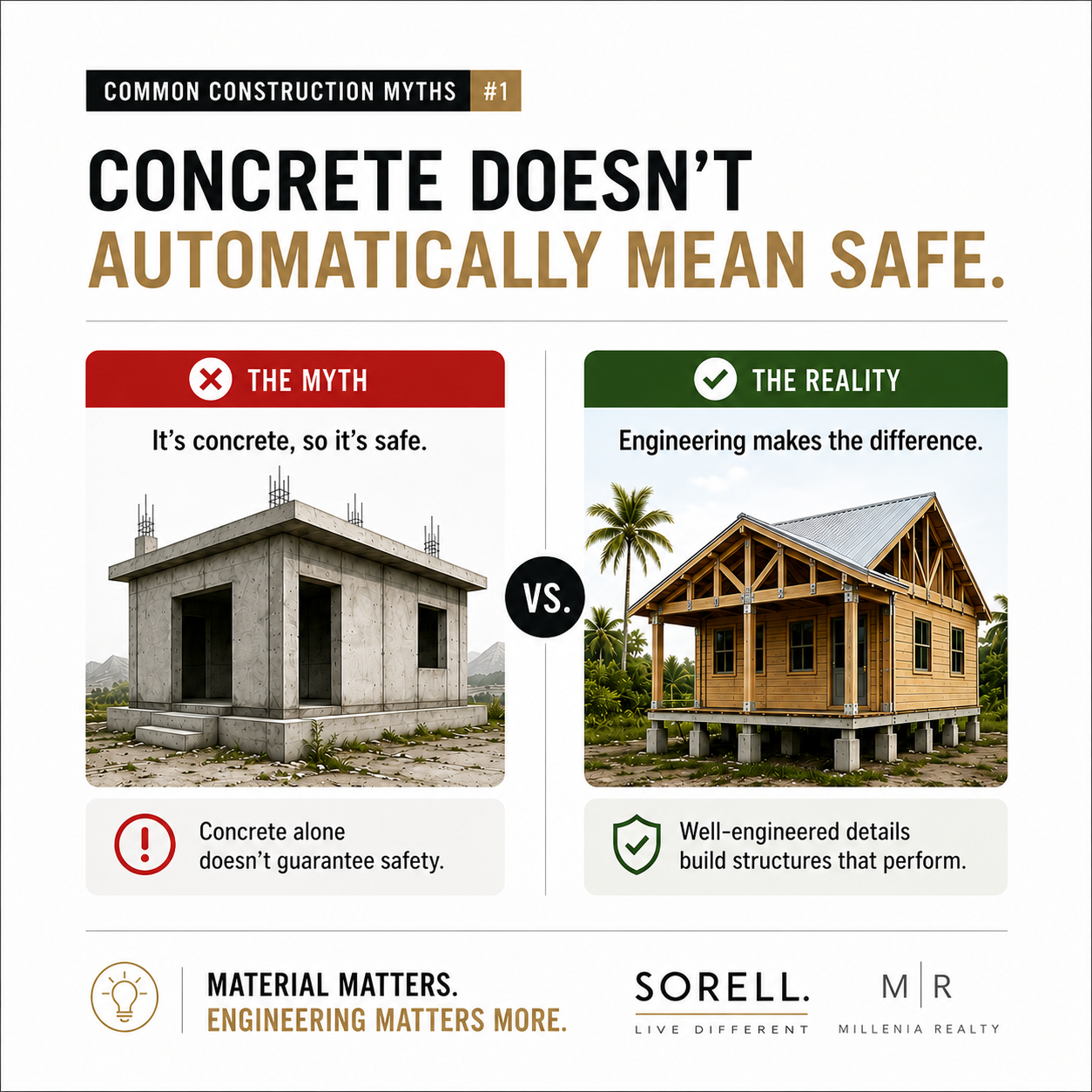
One of the biggest misconceptions we hear is this: “It’s concrete, so it must be safe.” We wish it were that simple.
We’ve inspected concrete buildings after major storms that suffered significant structural damage. We’ve also seen modest wood-frame homes come through with little more than cosmetic repairs. The difference wasn’t the material but the engineering.
Concrete is only one part of the equation. A building’s performance depends on things like:
• Proper reinforcement. Not just having rebar, but where it’s placed and how it’s detailed.
• Strong connections between the roof, walls, and foundation. This is where many failures begin.
• Quality construction practices, including proper curing and workmanship.
• A design that accounts for wind uplift as well as wind pressure.
A poorly reinforced concrete structure can fail just as easily as a poorly built wood one.
This matters across the Caribbean, where “all-concrete” construction has become almost synonymous with safety. We see it often through our work at Millenia Realty, where homeowners proudly market concrete construction as the major selling point.
Concrete certainly has advantages. But concrete alone doesn’t protect a family during a hurricane without good engineering.
If you’re planning to build, buy, or renovate, don’t stop at asking, “Is it concrete?”
Ask instead: “How was this building engineered to perform in a Category 4 or 5 hurricane?”
Have you ever been surprised by how a building performed after a storm?